

As Brazil’s 2026 presidential election approaches, my attention is drawn to the Amazon, a region where I am from and which I have been studying for many years through the analytical lens and ethnographic tools that anthropology has provided me with. In recent elections, the Brazilian Amazon has emerged as an important site of far-right electoral support. In 2018, Jair Bolsonaro the far-right candidate won in six of the nine states that make up the Legal Amazon 1 . In 2022, he was defeated in his bid for re-election nationwide, but he once again emerged victorious in most states of the region in the second round.
During the Bolsonaro administration, actions reflecting a clear anti-environmental agenda were undertaken, alongside explicit hostility towards the demands of Indigenous and Quilombola communities. Indeed, available data show a significant increase in forest destruction during Bolsonaro’s government, as well as numerous records documenting growing threats to Indigenous rights and increased vulnerability among other traditional peoples in the region. Despite this, he still enjoys considerable voter support in the Amazon region. In this article, I argue that the consolidation of the far right in the area cannot be understood if we continue to explain it through a narrative centred on a few major villains, as if the only way to account for these political transformations were to portray local far-right supporters as a whole as deliberate perpetrators of Amazonian destruction.
The challenges posed by this scenario require us to confront an epistemological task: refusing to dismiss as irrational or essentially envious those subjects whose ways of thinking we find difficult to understand or with whom we deeply disagree (Medeiros, 2024). Instead, we must recognise that far-right thought operates through its own forms of rationality (Alves da Silva, 2023), which we need to study and understand if we are to create pathways toward building something different. This article is an invitation to undertake this task, starting from the case of the Amazon. To begin confronting this challenge, we need to face the Amazon in all its complexity, recognising that the people who inhabit the region are far more socially and culturally diverse than the familiar images of the forest that circulate abroad might initially allow us to see. And we need to face the fact that many of these people, from different social classes, ethnic identities, and racial belongings, from large-scale agribusiness and cattle producers to small-scale farmers and miners, as well as ordinary people in urban and rural Amazonia who describe themselves simply as trying to make a living and build their lives through different means, are among those who have voted for the far right in recent years. A narrative centred on a few villains obscures the extent of this scenario and does little to help us understand what is happening; rather, it creates obstacles to investigating the deep roots of far-right support and the capacity of far-right rationality to spread locally.
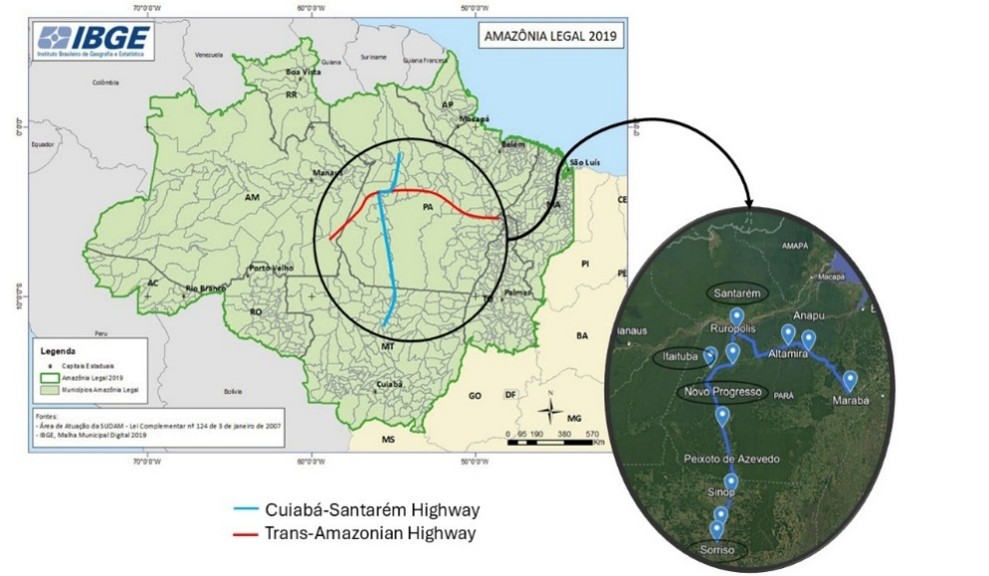
To investigate this spread and embeddedness, in this article, I present key findings on how far-right thought is articulated locally, drawing on long-term anthropological research along the Cuiabá–Santarém and Trans-Amazonian highways, an area that has consistently recorded high levels of far-right support in recent elections. The analysis is based on fieldwork conducted in 2018–2019 and 2025, digital ethnography of far-right political influencers’ social media accounts, and online mini-focus groups with Bolsonaro supporters from ten cities along the highways (see the map in Figure 1).
Figure 1: Cities along the Cuiabá–Santarém and Trans-Amazonian highways
When I first encountered these political tensions during fieldwork in the region in 2018–2019, I was concerned with the durability of colonial processes associated with the so-called “national integration roads”, a particular form of developmental intervention that has profoundly shaped many aspects of Amazonian social history. My goal was to turn the roads themselves into sites of anthropological inquiry, conducting archival research driven by them and carrying out fieldwork while moving between cities and communities shaped and transformed by their construction. I wanted to understand how the histories related to the highways were narrated and retold through words, materials, and landscapes, while building an ethnography of the lives unfolding in between places through a description of the experiences lived within the space-time of the road trips.
By then, I was primarily interested in the promises that the roads had brought into people’s lives and in the poetics that they could reveal and materialize. More specifically, I was asking what the roads in the Amazon could tell us about durable collective fantasies of society (Benjamin 1999, cited in Larkin 2013) in a nation-state formed by colonial histories (Souza Lima, 2002) and by the long-standing effects of racism (Gonzalez, 2021). To that end, the roads became my entry points for conducting a historical ethnography of the sedimentation of a common belief that I encountered repeatedly along my journeys: the belief that the Amazon was “backward” and “lagging behind”, and that its “real” demands were largely overlooked or neglected, giving rise to the perception that the region needed more. More development. More state presence. More progress. More interventions that would finally allow it to reach the future and unlock new possibilities for all its residents pursuing a better life.
My initial concern was therefore with the formation of ways of thinking in the face of the enchantment generated by promises of progress, asking how people come to think what they think, to desire what they desire, and to want what they want, as well as about the sociohistorical landscape embodying this genealogy. Within this framework, I argued in my doctoral thesis (Bemerguy, 2024) that the roads and their promises of conquest, wealth, land, and a better life functioned as veins of a continuously remade civilizational and racialised poetics, while also highlighting how their continuous deterioration and perceived unfulfillment over time have become both material expressions of the frustrations generated by the broken promises of capitalism and everyday reminders that reawaken the desire to see those very promises fulfilled.
Ultimately, these desires and aspirations for ‘more’, feelings of being unseen, left behind and wronged, as well as the deep-seated effects of colonial durabilities within which these affects and perceptions take shape (Bemerguy, 2024), became central to my investigation of the consolidation of the far right. I now turn to the histories and ways of thinking I have been tracing along the margins of these highways in order to offer a glimpse into the broader affective landscape of frustrations, desires for a better life, and demands for recognition that underpin the local strength of the far right. I begin, therefore, by returning to the histories produced around the roads themselves.
Histories that last
The Cuiaba-Santarem and the Transamazonian highways were built during the military dictatorship as part of the National Integration Program, a major developmental intervention created by the regime to address what it termed the “demographic void” in the Amazon and to mitigate perceived threats to national security and the region’s “backwardness.” The roads were framed as the solution to a territory described as a “land without men” and were publicly celebrated as a remarkable feat, the actual “reconquest of the Amazon”, and a patriotic milestone within the narrative of the “economic miracle” that the military sought to project at the time.
Alongside the construction of the highways, colonization policies were established and implemented along their routes. Following the decree ordering the immediate execution of these projects, a ten-kilometre strip on each side of the highways was reserved for this purpose and families began to be selected to receive land and subsidies to resettle and build their lives along the highway margins. Large areas of land were given to the so-called “Colonization Companies,” under contracts requiring them to ensure the creation of cities in the area. Military battalions were deployed from other regions of the country to participate in road construction. Older cities were profoundly transformed by the construction works and by the migration flows that these projects funded, enabled and encouraged.
As the years went by, new cities emerged as a result of the colonization policies implemented during this period, forging a scenario in which individual histories of migration, often narrated as a response to the nation’s call to help protect and integrate the Amazon became intertwined with a broader narrative of colonial conquest. These processes speak to the formation of a sociohistorical, symbolic, and material landscape in which the emotional pull of promises of land and a better life on an open frontier is continually reactivated through the retelling of the “pioneers’” achievements, those identified as the ones who arrived first and who are celebrated for the feat of conquest: cutting through the forest and clearing the land with their own hands, building cities where there had supposedly been “nothing”, and creating wealth from scratch.
These processes, of course, erase the fact that this was never a region with “nothing.” The peoples of the Amazon—in all their diversity, in cities, rural areas, and the forest, were already there, including communities with traditional ways of life deeply connected to nature and, among them, the diverse Indigenous peoples who have long made this territory their home, and whose lives and territories were violently affected by the development projects implemented during this period (Valente, 2017).
Both roads were officially inaugurated by the military in the 1970s, unfinished and largely unpaved. Over time, the Cuiabá–Santarém Highway became an export corridor of growing economic importance for agribusiness in central Brazil, attracting major political attention to its governance. This is crucial to understanding why the road became central to Jair Bolsonaro’s narrative regarding the Amazon during the 2018 campaign. By then, most of the highway had been paved, with a significant portion of the work funded through flagship infrastructure projects under the Workers’ Party (PT) governments—the so-called “Growth Acceleration Programs” (PAC).
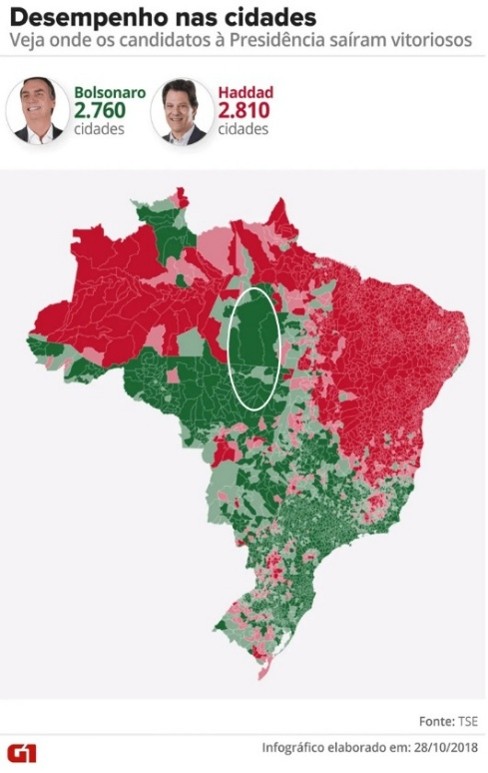
When Bolsonaro was running for office in 2018, the Cuiabá–Santarém Highway still had several unpaved stretches in Pará. These remaining sections were considered critical, the “most difficult to complete.” During the campaign, he promised to restore and complete the paving of the highway. He presented himself as the president who would finally hear the claims of those “hard-working men” who “suffered” annually from mud traps, severe traffic gridlock, and financial losses caused by supply chain delays, while also facing the “persecution” of those who did not like to work like them and what they described as the “Indigenous land demarcation industry” in the region. He won by a large margin in the roadside towns of that area (Figure 2).
Throughout 2019, the renewal works, carried out in “partnership” with the Brazilian Army, received significant attention on Bolsonaro’s social media channels. The work was undertaken by the 8th Engineering and Construction Battalion (8º BEC), the very same military unit deployed to Santarém during the military dictatorship with the “mission” to open the road.
In 2020, Bolsonaro “completed the highway,” as his government announced but, more specifically, what had been completed was a section of it, one of major interest to agribusiness, completing the paving all the way to the port of Miritituba, in Itaituba (Pará), where grain is shipped for export—thus fulfilling, on his own terms, his campaign promise. Following the “re-inauguration,” government social media channels continued to praise the roadwork while explicitly highlighting the connection between the Bolsonaro administration and the military presidents of the dictatorship era.
Meanwhile, much was happening in the Amazon. Scientific data showed a sharp increase in deforestation and fires; pressure on land intensified, as did the vulnerability of Indigenous and traditional peoples, especially during the pandemic. Reports of environmental irregularities multiplied, placing the Amazon at the centre of growing international disputes over Brazil’s position on climate change and environmental protection.
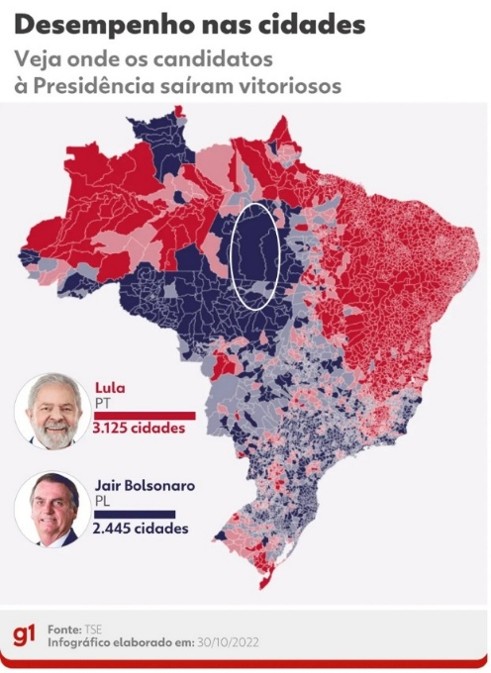
In 2022, after Bolsonaro’s electoral defeat, his supporters initiated protests across Brazil. Supporters from the road region, where he once again received very high levels of electoral support despite his nationwide loss, participated significantly in these mobilisations.
Figure 3: 2022 Brazilian presidential candidates’ performance per city
The four specific cities I selected for my fieldwork are particularly noteworthy in this context.
Sorriso, a city built by a “Colonization Company” in the 1970s and now known as the “national capital of agribusiness,” was linked to investigations into companies involved in financing the January 8 attacks in Brasília, an event often compared to the January 6 attack on the US Capitol. Like the events in Washington, the acts were fuelled by unsubstantiated claims of electoral fraud and sought to overturn the results of a democratic election.
Novo Progresso, the most pro-Bolsonaro city in Pará, is another city that emerged entirely after the road was built. It made headlines for the violence that erupted during protests blocking the Cuiabá–Santarém Highway, when gunfire and physical confrontations were recorded between Bolsonaro supporters and the Federal Highway Police (PRF).
Itaituba, an older city located between the two roads and the Tapajós River and deeply marked by the regional gold-mining economy while also serving as a strategic port hub for agribusiness export logistics, followed a similar path. There, Bolsonaro’s supporters halted traffic at the critical junction where the Cuiabá–Santarém Highway meets the Trans-Amazonian Highway
Finally, Santarém, home to the 8th Engineering and Construction Battalion—the same unit deployed during the military dictatorship and later praised during Bolsonaro’s administration for its work on the Cuiabá–Santarém Highway, became the site of a “patriot” encampment established directly in front of the battalion’s gates.
Having outlined how the region and its roads became entangled in these contemporary political events, I now turn to the reading of far-right rationality that I propose here. Such an analytical synthesis does not aim to exhaust all the elements I encountered in the field, but rather to briefly present some of the keyways of thinking that have repeatedly emerged from my ongoing investigation into far-right subjectivity in the Amazon, while examining them as part of longue durée processes that have found renewed and heightened expression through the consolidation of the far right in the region. This framework will help shed light on how we might continue to inquire into the spread and embeddedness of these affects and modes of thought, and how they have recently been captured and articulated within the far-right political project.
Some of What Far-Right Supporters in the Amazon Say and Think
Figure 4: Amazonian far-right supporters’ thoughts on themselves and the region
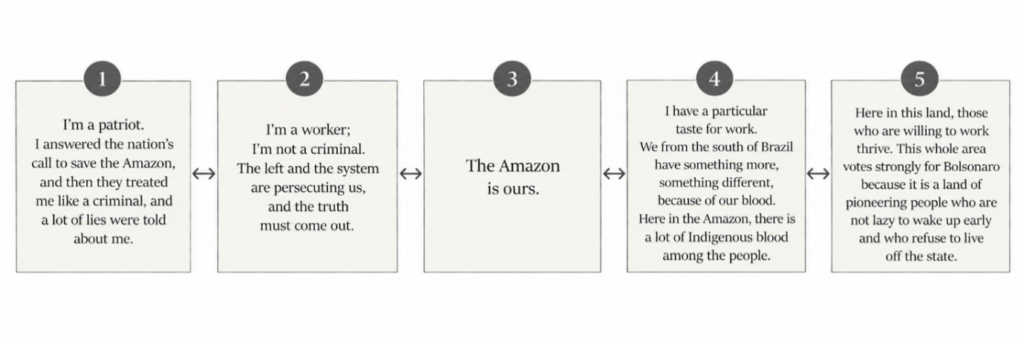
The first elaboration in Figure 4 is most commonly articulated by subjects who came to the highway area in the 1970s, amidst the major public campaign to conquer and colonize the Amazon region through the national integration roads. Yet the formulations presented above should not be read as discrete arguments. They overlap and reinforce one another, revolving around a shared moral vocabulary of work, deservingness, recognition, and wrongfulness.
The subjects who express the first elaboration came to the region for different reasons and under different circumstances, through official colonization projects that allocated land and subsidies to selected families; through colonization companies that were involved in building new cities in the region at the time; through the institutional displacement of military personnel and their families to the area; or through the decision to seek a better life in the region, responding to the campaign that emphasized how Brazil would be the future of the world, and the Amazon the future of Brazil. Despite these different trajectories, they found a shared meaning in the belief that they had answered the nation’s call, expressing deep resentment at not receiving the recognition they believed they deserved for their contribution to the nation.
At first sight, the perception that their decision to come to the region helped to “save the Amazon” appears paradoxical in the face of the high levels of environmental destruction brought about by the development projects they describe. But this apparent paradox is connected to a specific symbolic dimension of the interventions at the time, and to the way they were based on claims that other countries would try to jeopardize Brazil’s sovereignty over the Amazon because of what was represented as a “demographic void.” This contributed to a perception among my interlocutors that the “Amazon is ours” today because of the actions of the pioneers who ensured that the territory would be occupied. This, in turn, deepens their sense of being denied the recognition they believe they deserve.
The outrage expressed by my interlocutors emerges from the perception that time has passed and that “lies” have since been spread about them that deny them the recognition they deserve for their service to the nation and make accusations that they perceive as an affront to their morality, dignity, and character. These feelings come together with perceptions that vary in the extent to which they challenge the validity of official historical accounts and question what is understood as truth. In this sense, they question the way history is told about the military governments, expressing dissatisfaction and disagreement with its classification as a dictatorship, and presenting narratives about the injustice involved in erasing the importance of the military governments in securing sovereignty over the Amazon, as well as their own contribution to Brazil and to the region. Ultimately, this formulation connects to the broader picture of the long-lasting effects of the Military Dictatorship in Brazil and its relationship to the strengthening of the far right in the country, as well as to its specific dimensions in the Amazon, related to the colonial endeavour bolstered by the regime.
This sense of denied recognition becomes particularly acute in the second formulation in Figure 4, mostly articulated by subjects involved in land and environmental disputes. Given the complexities of local land-tenure issues, it is important to keep in mind that this argument is shared by actors occupying different economic positions, ranging from large-scale producers with extensive holdings and significant environmental violations to small landowners facing various difficulties in regularising their properties due to the overlapping of the areas where they make a living with reserve areas. Here, once again, they express resentment and outrage through a particular emphasis on the construction of their moral selves and on public recognition as hard workers. Within the moral field of the far right, the status of the worker speaks to their position within a political worldview that praises individual effort. Among my interlocutors, being publicly produced as criminals is experienced as a profound offence.
Here again, we encounter narratives that seek to question what is understood as truth, ranging from more radical, conspiratorial beliefs to more grounded perceptions that do not fully deny the validity of historical accounts and scientific data. These different perceptions come together with the direct production of the left as their tormentor.
First, they attribute to the left the growing attention given to the environmental agenda, which they associate with their being framed as criminals in the public eye. There is a factual basis to this perception in the changes to the administration of environmental issues following the country’s redemocratization, which led to major initiatives in land regularization and environmental protection, as well as to the creation of a significant number of protected areas, national forest reserves, and Indigenous demarcations in the region, particularly during left-wing administrations (Lacerda, 2024)
They also attribute to the left and to the “system” the responsibility for history having been told in the “wrong” way, expressing a feeling of being unseen in their personal struggles to thrive, alongside a sense of being persecuted by external actors to whom they often attribute hidden, envious interests. At this point, once again, we encounter the formulation “the Amazon is ours,” this time in a sense that seeks to reclaim their recognition as Amazonian residents, as they claim that they are not seen in discussions that portray the Amazon as if it were only a forest to be protected. In affirming their relationship with the territory, they express a strong rejection of what they perceive as the imposition of external perspectives on the region, claiming that they know more about the region’s needs than those who do not live there and, in particular, than those who do not experience its everyday realities. All of this is expressed through a deep resentment of being treated as criminals when what they expected was recognition for their hard work, their struggles to build a better life, and their desire for more opportunities.
Yet, despite some references to factual events, at the core of this shared argument also emerge key conspiratorial beliefs about the relationship between the left, NGOs, and hidden international interests that allegedly seek to undermine economic growth in Brazil through indirect control over how the country can exploit the natural resources available in the Amazon. Here, the formulation “the Amazon is ours” emerges, imbued with a patriotic sense of protecting both the nation’s natural wealth and its sovereignty in the region. Within this narrative, the left is portrayed as a “sold” actor that accepts interference from other countries because it receives funding from organisations and funds created to support the environmental agenda and allegedly uses this money to perpetuate itself in power.
Within this framework, we find more radical questioning of the truth of scientific data concerning the destruction of the forest and its relation to global warming, as well as of historical accounts related to the Military Dictatorship. We also encounter a range of local discourses about how “the truth about the Amazon” must come out and about the need to support the far right to “beat the system” and “put an end to the persecution of hard-working people”.
Yet, it is important to highlight that the image of the “hard working man” emerging from these narratives is not racially neutral. The elaboration concerning “blood” makes explicit the racialised dimensions of disputes over how the Amazon’s problems are understood over time and, once again, reveals ways of thinking among far-right supporters connected to the affective reservoir of resentment emerging from the production of “labour” as a core individual value.
This argument must be read through the lens of the durable effects of a colonial presence produced through the conquest endeavour that has shaped the history of this area, as well as its connections with the colonial projects implemented during the Dictatorship.
In my PhD research, I analysed reports from the National Truth Commission to demonstrate how the “solutions” devised by the military for the so-called “Amazonian void” were, in many respects, managed as a racial problem. The documents revealed that the military bureaucracy treated the Amazonian territory and its people as a site of specific psychosocial issues, framing both the “problem” and its solutions around the region’s high percentage of “Indigenous blood.” Through a eugenic logic, these reports framed “Indigenous blood” as a marker associated with laziness, incapacity for labour, and inertia.
A racialised logic was also present in the propaganda used by the military to promote the National Integration Program (PIN), the road projects, and the colonisation policies derived from it. Studying some of this advertising campaign, I found that—despite the stated objective of using the roads to address agrarian issues in the Brazilian Northeast, the programme also recruited settlers from Southern Brazil – a region perceived as whiter because of its historical connection to colonial projects that brought European families to the country. These specific families, White families, became the face of the programme. Their European descent and phenotypic traits were highlighted in marketing campaigns designed to showcase the success of this “new Amazonian conquest” made possible by the roads.
During my interactions with far-right supporters about the Amazon’s problems and the history of the cities, I found this racial entanglement expressed in the fourth formulation presented in Figure 4. I brought it to this article to highlight that, in one of its dimensions, the figure of the hard-working patriots who resent and cast themselves as victims—claiming to be the target of lies propagated by the left (about the Dictatorship and about the Amazon), while also resenting the erasure of their contributions to the nation, ultimately expresses a sense of themselves as a wronged White man.
It is important to keep in mind that the sense of rejection and the narratives of victimisation are forged within a colonial background that fostered a self-image deeply marked by narratives of White superiority. In this sense, the figure of the hard-working patriot is not only produced through a moral valuation of labour, but also through a racialised understanding of who is entitled to embody the qualities associated with work, productivity, and the capacity to build the nation and the Amazon’s future. This way of thinking is also related to local dimensions of racism towards Indigenous peoples and their effects on everyday life in this region, which has been shaped by significant state-sponsored migration flows from other parts of the country. This racism is expressed in perceptions that associate the Amazon’s difficulties in achieving progress with the extensive presence of Indigenous lands or with the high proportion of “Indigenous blood” among its population. This relationship still requires further investigation
The final formulation in Figure 4 brings these elements together through a perception that praises the results of individual effort to thrive in life through work. The affirmation that, in this land—the Amazon—those who are willing to struggle through work will thrive brings together two important dimensions of far-right discourse in both its general and local iterations. First, it reveals a deep belief in a hyper-individualist worldview grounded in neoliberal perspectives, one that largely rests on the idea that only individual effort is what separates those who succeed from those who do not. This hyper-individualist framework, which imbues the capacity to thrive through one’s own efforts with moral value, is a core feature of far-right morality worldwide.
The second dimension of this argument emerges from the region’s durable colonial histories. Insofar as this area is surrounded by stories of pioneering people who made fortunes from scratch, cities created out of nowhere, and lives positively shaped by the promises of the moving frontier, the perception that those who are willing to work will thrive is deeply embedded in the affective, material, and symbolic landscape created by the images and promises of the moving frontier. These remain present in everyday life through arguments that frame the Amazon as a tabula rasa for those determined to conquer it through hard work.
Here, the frontier landscape acts as a space where ‘deservingness’ through labour is naturalised, fostering a specific vision of personal success that enables the meritocratic rhetoric of far-right political ideology to resonate locally. In this way, this argument allows us to see how the landscapes of the opening frontier function as fertile ground through which far-right ideology can become embedded in everyday life – through the very act of moving along roads shaped by deep-seated colonial memories, through the constant celebration of pioneering founders, and through the daily reliving of promises of attaining “more,” repeatedly remembered as broken amid unfulfilled development projects that they blame on the “system”: NGOs, interference from other countries, environmentalists, Indigenous activists, and the left. All of this has paved the way for people to find meaning in the far right’s discourse and promises for the Amazon.
Digging into deep-seated frustrations
“The people of the Amazon, the riverine dweller, the small-scale farmer, the extractivist will not be treated as criminals for making their livelihoods from the land. The State owes them guidance and support for the responsible use and preservation of natural resources, not the persecution that today falls most heavily on those who have the least. We will put an end to policies that criminalise forest dwellers, replacing blind punishment with a path towards guidance, regularisation, and opportunity”
I wish to conclude this article with a quote drawn from the government platform prepared for Flávio Bolsonaro—Jair Bolsonaro’s eldest son and designated as his political heir in Brazil’s 2026 presidential elections. In the section addressing the Amazon, the platform mobilizes the exact same grammar of victimization and persecution voiced by many of my interlocutors, artfully fusing it with promises of economic opportunity. Reading this excerpt in light of the key arguments presented here serves as an invitation to confront a disturbing realization: the far-right has found its way into the lives of many Amazonian residents by appealing to deep-seated frustrations and genuine desires and aspirations for a better life. This aspect has proven to be a central dimension of the far-right’s consolidation in Brazil and other Global South countries in recent years (Pinheiro-Machado et al, 2025)
Throughout this essay, I have questioned prevailing explanations that reduce this complex landscape to a narrative centred solely on the primary villains of Amazonian destruction. Instead, we must confront the persuasive power of the arguments and promises articulated by the far-right in the region and understand how they resonate with ordinary people. This requires examining how their appeal intersects with historically embedded ways of imagining the future dispositions shaped by enduring sociohistorical processes that have generated a cyclical rhythm of grand promises and perpetual unfulfillment. These dynamics trace back to the developmentalist interventions of the Brazilian Military Dictatorship and the country’s colonial heritage, both inextricably bound to durable, racialized perceptions of self, labour, and territory. Grasping these deep historical alignments and revealing how they cultivate a receptive terrain for far-right ideology to resonate organically and circulate with persuasive force, is a crucial prerequisite for rethinking our analytical approaches and offering meaningful alternatives to those who have come to find recognition, value, and hope in far-right rhetoric in the Amazon.
*Dr. Telma de Sousa Bemerguy is a Visiting Academic at the Digital Economy and Extreme Politics Lab (DeepLab) in the School of Geography at University College Dublin and a Postdoctoral Researcher at the Brazilian Centre for Analysis and Planning (CEBRAP). She earned her PhD in Social Anthropology from the National Museum, Federal University of Rio de Janeiro (UFRJ).
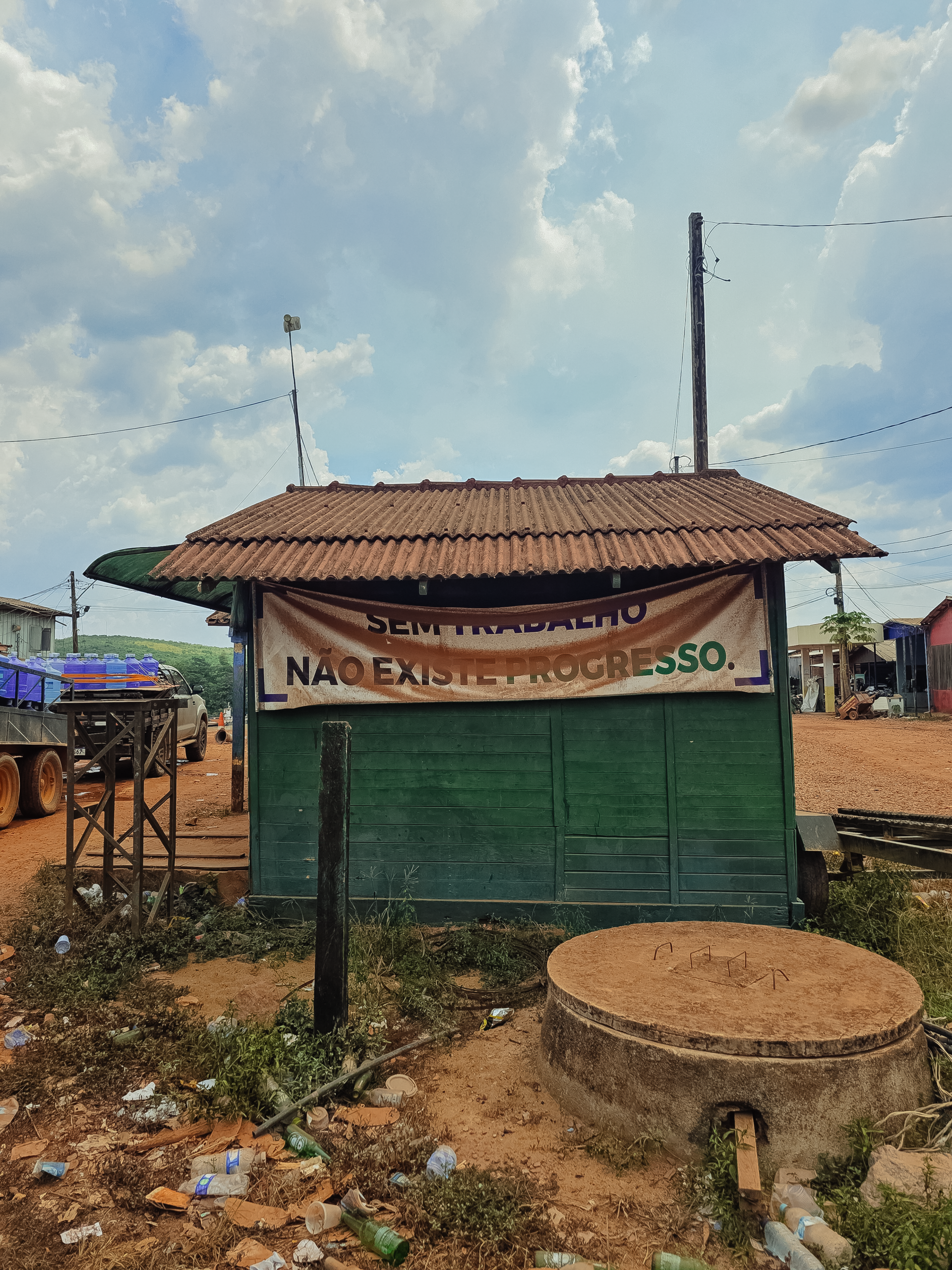
Photo taken in the Jardim do Ouro community, district of Moraes de Almeida, state of Pará, Brazil, by Telma de Sousa Bemerguy (October 2026). The sign reads “There is no progress without work.”
Notes
[1] The term Legal Amazon (Amazônia Legal) refers to a socio-political and administrative designation established by Brazilian federal law for regional planning and environmental governance. Covering approximately 59% of Brazil’s territory, it spans nine states (Acre, Amapá, Amazonas, Mato Grosso, Pará, Rondônia, Roraima, Tocantins, and western Maranhão) and encompasses the Amazon biome alongside portions of the Cerrado and Pantanal (IBGE, 2021).
References
Alves da Silva, W. 2023. Os remédios da nação: da controvérsia medicamentosa no contexto da pandemia de Covid-19 no Brasil. PhD diss., Museu Nacional, Universidade Federal do Rio de Janeiro (UFRJ)
Bemerguy, T. S. 2024. “Estradas da conquista e caminhos da raça: a durabilidade da presença colonial na Amazônia brasileira” [Roads of conquest and paths of race: the durability of colonial presence in the Brazilian Amazon]. PhD diss., Universidade Federal do Rio de Janeiro (UFRJ).
Gonzalez, L. 2021. “Racism and Sexism in Brazilian Culture.” Translated by Bruna Barros, Feva, Jess Oliveira, and Luciana Reis. WSQ: Women’s Studies Quarterly 49 (1–2): 371–394. https://doi.org/10.1353/wsq.2021.0027.
IBGE (Instituto Brasileiro de Geografia e Estatística). 2021. “Amazônia Legal.” In Quadro geográfico de referência para produção, análise e disseminação de estatísticas, 53–55. Rio de Janeiro: IBGE. https://www.ibge.gov.br/apps/quadrogeografico/pdf/19_Amazonia%20Legal.pdf.
Lacerda, R. B. 2024. “Patriotas da BR-163: ressentimentos, nostalgia e a humilhação da lei na fronteira” [Patriots of the BR-163: resentment, nostalgia, and the humiliation of the law on the frontier]. Antropolítica: Revista de Antropologia 56 (3): e62574. https://doi.org/10.22409/antropolitica.i56.v3.a62574.
Larkin, B. 2013. “The Politics and Poetics of Infrastructure.” Annual Review of Anthropology 42: 327–343. https://doi.org/10.1146/annurev-anthro-092412-155522.
Medeiros, J. 2024. “Quando personagens extremistas entram em cena: a campanha golpista dos patriotas (2022-23)” [When extremist characters enter the scene: the patriots’ coup campaign (2022-23)]. In Direitas, radicalismos e as disputas pela linguagem de direitos no Brasil, edited by Adriane Sanctis de Brito and Luciana Silva Reis, 85–110. São Paulo: Fundação Friedrich Ebert; LAUT – Centro de Análise da Liberdade e do Autoritarismo.
Pinheiro-Machado, R., Rivera, M. P., Alves da Silva, W. G., Ray, R. G., Frid, M., & de Souza, J. M. (2025). Flexible work, rigid politics: Platformization, aspirations, and the making of the authoritariat in the Global South. Dialogues on Digital Society, 1(3), 343-347.
Souza Lima, A. C. 2007. “Traditions of Knowledge in Colonial Management of Inequality: Reflections on an Indigenist Administration Perspective in Brazil.” e-Journal RAM-WAN 1 (3)
Valente, R. 2017. Os fuzis e as flechas: história de sangue e resistência indígena na ditadura [Rifles and arrows: a history of blood and Indigenous resistance during the dictatorship]. Rio de Janeiro: Editora Companhia das Letras.