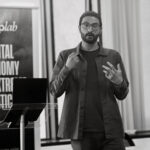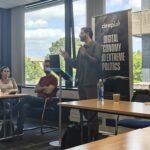
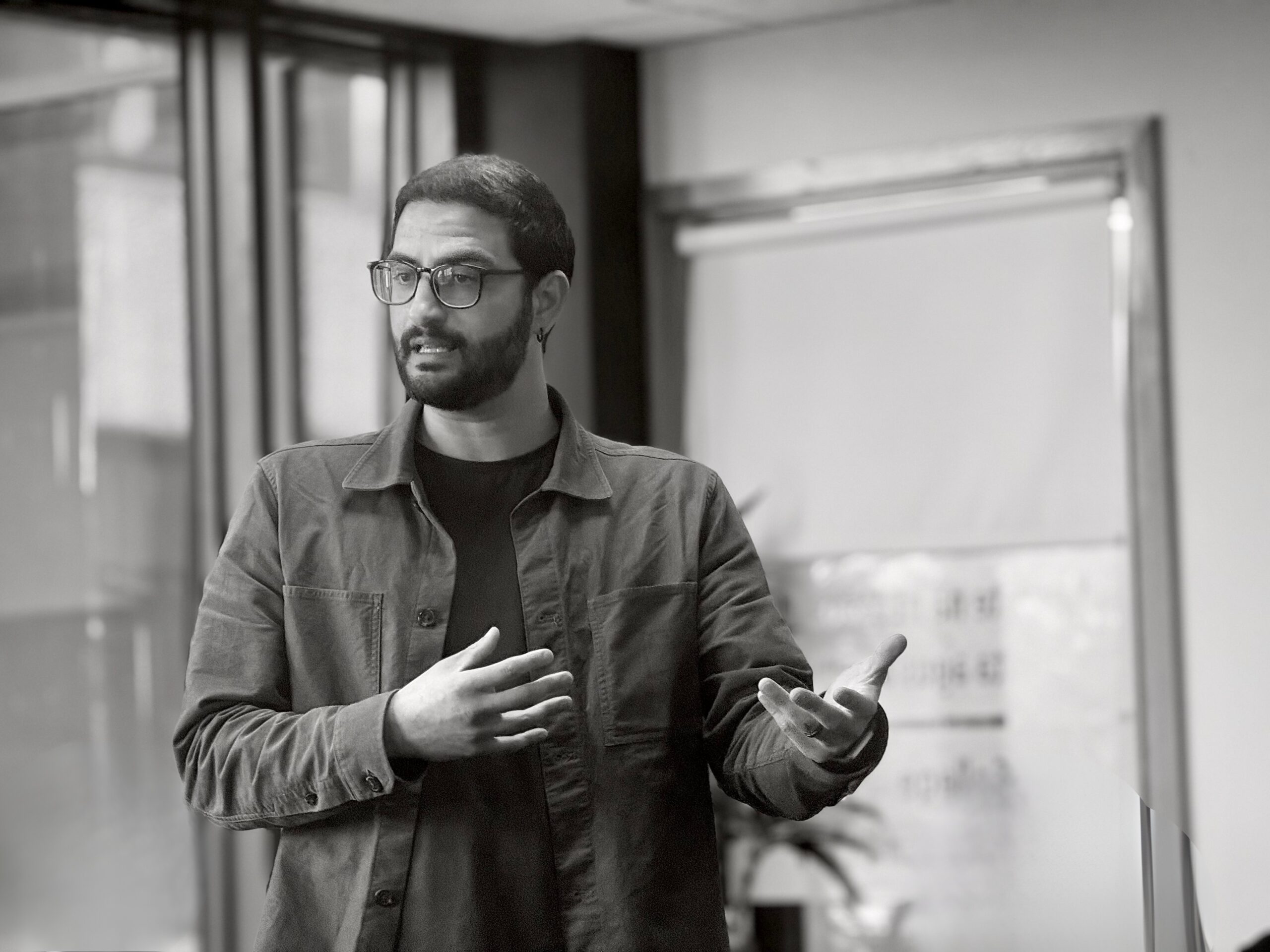

Before the summer break, on the 23rd of June, Dr Rodrigo Campos gave a talk for the Deep Thoughts Seminar Series about his doctoral research on evangelical activism within the Brazilian military police force. He sat with DeepLab member Dr Wagner Alves da Silva to discuss his ethnographic fieldwork and experience investigating the topic. Dr Campos earned his PhD from the University of York, where he was a postdoctoral research associate in the Department of Politics and International Relations. He is assuming a new role at King’s College London this term. Wagner – What initially drew you to explore the intersection of religion and politics, specifically Evangelical activism within Brazil’s security forces? Was there a particular experience or broader context that sparked your interest? Rodrigo – So I have a background in international relations, both the undergrad and the master’s, and I did politics in my PhD at the University of York. Traditionally, my area tends to be very positivist and tends to take grand theories or concepts and apply them to reality, as if you can do that, as if reality is just waiting for a theory to be interpreted. But I have been very drawn to ethnographic work since the end of my master’s, when I started doing documentary films in war zones like Western Sahara, in the Gaza Strip, and the Rafah Crossing between Egypt and Gaza. I have done work in Brazil on far right activism in the education sector. I have done ethnography in England more recently with volunteer groups in the police. Wagner – In your research, you link Evangelical police chaplaincies with Brazil’s far right. How do you understand these far right forces? Would you say they form a coherent political movement, or are they better seen as a coalition of diverse actors with overlapping goals? Rodrigo – Yeah, I completely agree with you. I do not think you can see the far right in Brazil as a coherent agenda, because there are so many different interests involved, so many different social groups that in the normal days of politics are all fighting amongst themselves. They are fighting for power, for visibility, but when it comes to critical junctures, like in elections or during a deep crisis, they can cooperate in certain things. I think, in my case, I was trying to understand a very peculiar manifestation of the far right in Brazil, which is this entwinement between religion and violence, or religion and security, which is very prominent. So, you have the evangelicals and the police, who are probably the strongest electoral strongholds of Bolsonarismo in Brazil. But instead of seeing how they cooperated, I was trying to see how they were entwined, how they became one force, so to speak. So, yes, I do not think you can see them as one force. They are very diverse, but when it comes to key junctures of crisis, they can cooperate. Wagner – Your thesis discusses the idea of ‘new Christian Militarism’ as shaping social order. How do you think this has influenced public views on authority, violence, and morality, especially in marginalised communities? Rodrigo – That speaks directly to my research. As you said, you mentioned the idea of a new Christian militarism, and if we call it new, it means that there was an old one. So, what I did in my historical chapters was to understand how this kind of entwinement between Christian ideology and military force has been foundational to the state-making enterprise, but also to the development of capitalism in Brazil. How capitalism developed as a mode of production was not only through the use of violence against marginalised populations, such as the native indigenous groups, but also during a series of rebellions in the 18th and 19th centuries against the Brazilian Empire. It is never only about group force. There is always this kind of morality or ideological work to discipline people that otherwise would not accept the colonial occupation or the theft of their land, to integrate them into the workforce, to become labourers. And religion has played a major role in that, but from a Catholic perspective during most of the time. And so, back then, over nearly 500 years of history, it was this verticalized idea of Catholicism as being deeply enmeshed with the politics of colonialism and later with Empire, that set out to construct these imposed moralities on marginalised populations. But what we see towards the end of the 20th century is that, increasingly, because evangelicalism is growing so much in the country, those strategies of conquering with force, but also with this compassionate religious element, has become more decentralised, and the police, which is the group that I am studying, takes advantage of that view. Wagner – Fascinating. Then how do we counterpoint this? I mean, is it possible? Rodrigo – I think it is possible, and one of the things I am going to speak about later today is trying to understand why and the ways in which police officers feel they accept this religious message. It has to do with precarity. It is not only because the police are violent, and they espouse a far right ideology. The police are victims of the system themselves, especially low-ranked police officers, who tend to be racialised people. They come from marginalised backgrounds in urban areas. So, police labour in Brazil is very precarious, okay? It is high risk, and the police are going through a mental health crisis. That mental health crisis is the entry point for evangelicals, because they are coming in to offer free work. There is no financial burden on the State. They are providing mental health counselling, and they are saving many police officers from committing suicide. They are strengthening family values. It is very conservative, we must problematize, it is complicated in terms of ideology, but we also must pay attention that they are saving people. Not only the police, we see that in communities, but in my case, I am studying the police. So, this means that the reason why you have this crisis is because of decades of underfunding of the State. Neoliberalism has created a situation where you have to cope with the burdens of high-anxiety work, like the police, on your own. And you feel alone, feel invisible in society. Wagner – Your point is fascinating because, from what I have seen in the literature and my own research, precarity seems to be a key factor in how people become connected to far right movements Rodrigo – Absolutely, yeah. It is like the material base from where conspiracy theories emerge, but also from where strong bonds between these people are constructed. They see themselves as a brotherhood that is trying to save not only themselves as police, but people who have, in their words, ‘fallen into violence’ or ‘fallen into evil’. So, I think, as ethnographers, we need to have an empathetic look at it. We cannot just take a theory and impose it, and say: ‘these people are irrational’, ‘these people are mad’, ‘they are weakening democracy’. That says nothing about the everyday lives of these people. Wagner – You told us about the idea of new Christian militarism, but I wanted to ask you about this idea of missionary activism, which is a central concept in your thesis. How do you define this form of activism, and what distinguishes it from other types of religious engagement in the public sphere, particularly in its interaction with militarised institutions like the police? Rodrigo – I do not see a distinction between what evangelicals are doing in the police or any other place, like a hospital, like a school, in the Parliament. The idea is that the missionary force of evangelicals is a life mission. To become evangelical – and I say this because when I was a teenager, I was converted, and for a short period in my life, I was a reborn Christian, so I kind of understand where this comes from – it is the creation of a new person. You leave behind a world of fear, of hatred, of precarity, and you embrace — the idea of embracing the gospel and being one with Christ is to create a new man or a new woman who is not fragmented but wholesome. When you achieve that phase, the rest of your life needs to be dedicated to doing the same for other people. If God’s grace has touched you, you need to go on and spread the good news to the rest of the world. So, missionary activism is intrinsic to the life of any evangelical. Wagner – Given the growing entanglement between Evangelical activism and militarised security forces, what do you see as possible paths forward? Are there spaces for resistance, reform, or reimagining these institutions, or do you think we are witnessing a more entrenched transformation in Brazil’s social and political order? Rodrigo – Look, I think that is a very complex question, and if I had the answers to that, I would not have to be here today; everything would be solved. But I will say this, focusing on what I’m currently researching. When you read the manuals and the books that are inspiring this type of activism, which I will show later in the presentation today, it is like hundreds of books about being Christian and being a police officer, about what the mission of the police is for Christ. A lot of the things they learned, they learned from liberation theology. They say that explicitly. *Dr Wagner Alves da Silva is an ERC doctoral researcher at the UCD School of Geography. He has a PhD in Social Anthropology from the National Museum, Federal University of Rio de Janeiro.
So, I am really interested in understanding how this type of activism is articulated in the margins of power, not from the centre of power and then outward, which is how we tend to see figures like Bolsonaro or even party politics or elections. I tend to look away, not that I do not think they are important, they are very important, but I tend to see how they operate in less spectacular ways. So, outside the sensationalist narratives of the media. what does the everyday life of an evangelical police officer look like? That is my approach to ethnography. When you do that, there is something else that I mentioned: you encounter the uncanny and the unexpected. When you set out to do something, you have your intentions, an idea of how these people think or what you are expecting from them. But when you do fieldwork, you discover so many new things that even completely change your own theoretical orientation.
So, I discovered that the Federal Government in Brazil under Bolsonaro was rolling out a policy of spiritual assistance for the police through an informal conversation with an evangelical chaplain in the police. It was not supposed to happen, but those kinds of informal compacts — building a network with interlocutors — that is what I am really into from a more methodological perspective. And so, I have been trying to do an ethnography of the far right. That is what my approach is. It is a bottom-up approach to the far right.
So, whenever the police in most urban centres go on to some special operation in a favela, in a marginalised community, where they need to reconquer the territory, they use this kind of terminology very explicitly. They are, more and more, bringing in evangelicals for the second phase of the concrete, which is to build the community policing phase of those interventions. And the idea is that once you remove criminal gangs or even malicious from periphery territory, you need to reconstruct order from below, and you do that by mobilising evangelical leadership and having them bolster legitimacy for the police, but also engage in charity, engage in all sorts of different social activities with the population. So that colonial logic of occupying, conquering, but moralising people, is still very much present to this day in Brazil.
And that is what I am interested in because it means that the far right, and I am sorry to extend myself, does not depend on institutional projects to grow. They do not depend on elections anymore. They do not depend on a figure like Bolsonaro to grow. These things are happening at the margins because the police have so much autonomy; they can do whatever they want. So, essentially, the far right is occupying spaces of power, but also spaces of everyday power, of the police, popular community security councils in every neighbourhood that we have in urban cities in Brazil, and that is really where I think order is being constructed from below. So, this is my ethnographic approach to understand the far right.
That is how the police officer feels. And I’m sure we can extend that to many, many other sectors in society. But then, from that, they have a completely different base-building work of indoctrination, of justifying police violence. I think the solution, I am not sure there is a solution as such, but the way we must look at this is: we need to reform the police, and the State needs to play a bigger role in that. I think the militarisation of the police plays a strong role in fostering these types of conservative ideologies within the police. I think demilitarisation is a way forward, but also investing in hiring psychologists, hiring therapists, so that these officers can be cared for, because they are labourers, they are workers as well.
It is not that we must be compassionate with the police who are violent, but we need to be compassionate with the figure of the police officer who themselves are a victim of the system. That is how I see the problem.
What happens is, because a lot of officers are themselves… their faith is evangelical, they just adapt that to the language of police. I think the way they adapted is very planned, it is highly rational, highly intellectualised. They write books about this, they study, they do research within the police battalions. They conduct surveys to make sure that their service is more efficient. So, for them, missionary activism is about establishing the equivalence of policing with being a soldier of God or a soldier of Christ.
The police are not only a constitutional force; it is a divine force. If you go to, for instance, Romans 13, which I told you before, it says that every authority is established by God. So, therefore, to be against the police is to be in sin, it is a heinous crime. By establishing this equivalence, police labour is justified, and police violence can be justified, and so forth. I would say missionary activism is the same for every evangelical in the world; it is a global, universal value. But for each different institution where they are trying to penetrate and build from the basis, they adapt the language. Because they are police officers themselves, they know how to approach, let’s say, the heart of men in that specific area.
There is one guy, an ideologue from the Military Police of São Paulo — one of the founders of the Associação dos PMs de Cristo (Officers for Christ Association), which is probably the most traditional one in all of Brazil, though not the largest — and he said that the way they approach or the way they ‘penetrate the heart and the mind’ of the police is very similar to how liberation theology used to operate in favelas and rural communities during the dictatorship, from the late 1960s through the 1980s.
But they [liberation theologians and the progressive left] have abandoned that: the idea of not only doing policy when you are in government, of just monetary redistribution, which is really what Lula has become about, that is what he embodies nowadays. Evangelicals are now the ones doing what liberation theology used to do — being part of the community, sharing in the pain, doing voluntary work, not just charity. I think Frei Betto really encapsulates that idea well: you are not only giving bread, but you are also explaining why you are giving bread. And that is exactly what evangelicals are doing today.
They were taught by liberation theology, which they now oppose, because they are anti-communist and everything else, but the progressive side, the left, has abandoned the base. You know it yourself; you have been working in the favelas. Where are they? You have some NGOs here and there, but they are micro-scale, right? And we have been saying this for a long, long time. Everyone on the left knows this, but it seems we cannot have a serious debate or take initiative.
So, I think that is not the solution, but I think that is how we need to set our minds. We need to think this way: maybe we should relearn from them now — the way they use social media (and they are very prolific in that), the way they build their bases with communities, not only in the police, but even more so outside of the police, anywhere. It is not only with the poor, but also with the middle class, the rich — with everyone. They are showing that ideology still matters in politics. So, I think that is how we need to think about this issue.