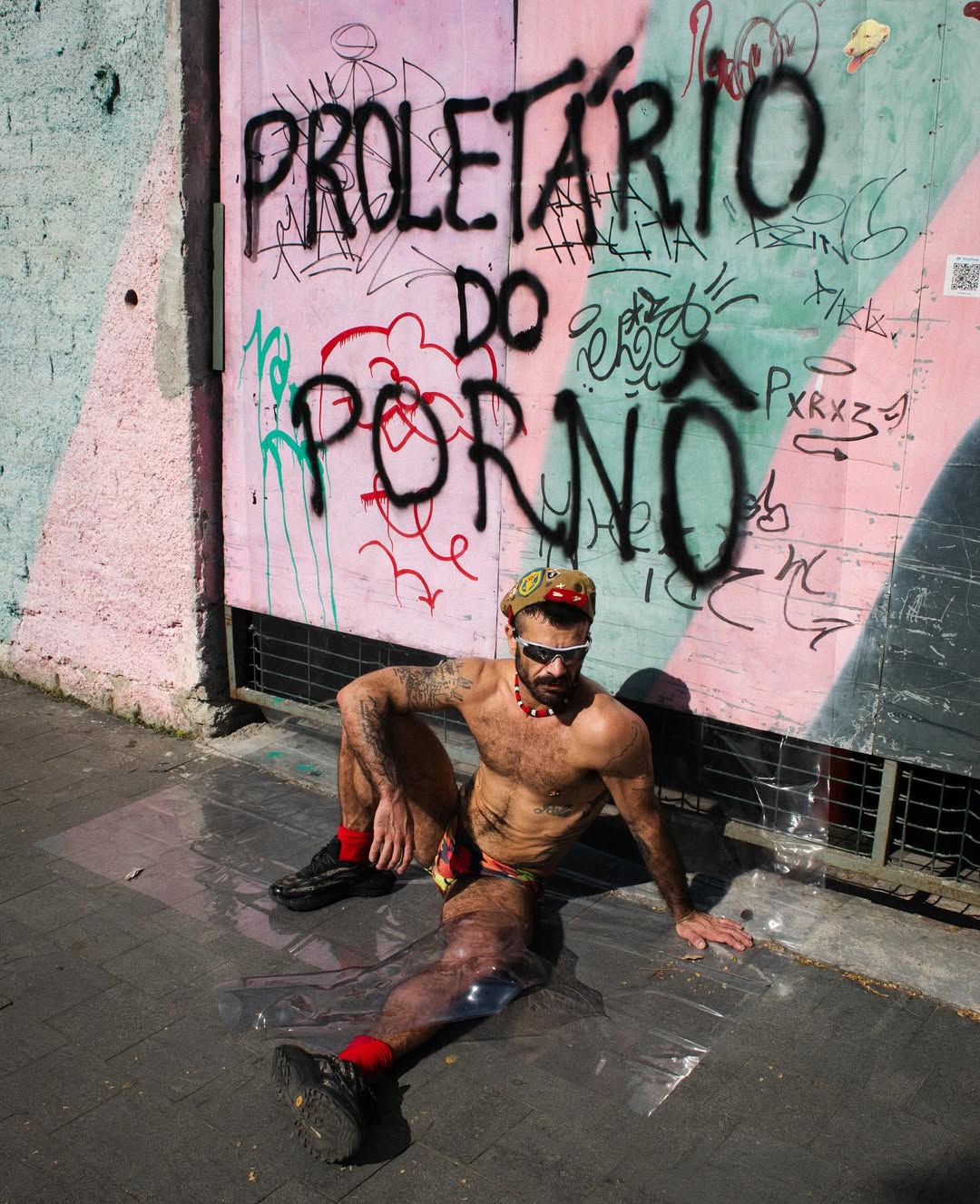

Translation: Proletarian of Porn – Photographer: Ezequiel Aguilera (@ezeruludo) | Model: Fernando Brutto (@fernando.brutto) By Gianluca Oliveira-Soares* Producing adult content for platforms such as OnlyFans has become a common occupation among young adults (Warin et al., 2025). News websites frequently mention OnlyFans, usually highlighting the high incomes that the activity can generate, often exceeding what these young adults would earn in the formal labour market. A Brazilian song by influencer Bibi Babydoll illustrates this perception well: ‘I wasn’t born to work as a CLT [formal job], I opened my OnlyFans and it’s photos that I’m going to sell’. Artists with great appeal among young people, such as Cardi B, Anitta and Tyga, also create profiles on these platforms. However, there is something ‘quite strange’ about this media overexposure of superstars with high earnings on digital sex platforms. In short, the activity consists of producing and hosting sensual or pornographic photos and videos on subscription content services. However, the work dynamic involves other processes to ensure engagement and build a subscriber base. Despite the overexposure of the topic, the discussion about platformised sex work has not been carried out in-depth, as a report by Fairwork discusses. Fairwork’s report presents the first major study on decent work for digital sex workers, examining aspects such as means of payment, working conditions, contracts with platforms, self-management of work and class representation. The data summarised in the study comes mainly from female cisgender workers, and the points of attention highlighted were: instability of payments/income, reimbursement policies and platform commissions; harassment, sexual abuse and stalking, lack of protection for minorities, doxing and scams; lack of contractual clarity, transparency in content review and data processing; lack of communication channels with the platform and unilateral suspension of accounts without appeals; and the need for class representation. In general terms, sex work involves the consensual trade of sexual services between adults (Piscitelli, 2005). It is crucial to emphasise that in order to be considered sex work, consent and the age of majority are required, otherwise it is always sexual exploitation. Platformised or digital sex work is one of the ways in which this trade is carried out, with the intermediation of platforms for hosting content and interacting with clients. The existence of online sex work dates back to the 1990s, before the rise of companies like Uber in other niches of the labour market (Knight, 2016; Kruse, 2024). Current digital platforms specifically designed or used for the trade of sexual services include OnlyFans, Cam4, Chaturbate, and XvideosRed, among others. However, as Caminhas (2025) explains and following the same path adopted here, the production of adult content online involves a diversity of platforms. It is difficult for a worker to be on just one, and the activity also extends to social media such as Instagram, Telegram and X/Twitter. It is a complex ecosystem whose purpose is to co-operate with the main tool for attracting and retaining subscribers and followers in digital sex work, that is to say, intimacy (Rand, 2019; Jones, 2020; Ryan, 2019). It is in this need to develop intimacy that the strategy or ethics of online influence arises, a more recent feature of this activity, as Lorena Caminhas (2024) points out in her report on digital sex markets. During my fieldwork between 2020 and 2022 and ever since, I have been following social media profiles of sex influencers, Brazilian and international. While conducting interviews, one of my interlocutors said, “I’m not Anitta, nor Madonna,” referring to his surprise at being recognized on the streets and having people express admiration for his work and idolize him, as if he were a star like “Anitta, Madonna or Lady Gaga”. He was concerned about the type of content he produced and the impact on the people who consumed it, as he considered his performances to be unfeasible or unenjoyable for many. At the same time, other male content creators were publishing posts on ongoing political topics, such as defending vaccination, public health, and the landless movement, taking a stand against the government of Jair Bolsonaro, denouncing the non-transparent policies of OnlyFans, and campaigning for the election of progressive governments. One of them was doxed after promising to reveal his face if Lula won the presidential elections – far-right groups discovered photos of his teenage years and published them on social media. Though many adult content creators were simply selling pornographic photos and videos and did not post about anything beyond sex, others, by contrast, evolved into “sex influencers.” This concept can be considered a transformation of Pezzutto’s (2019) concept of ‘porntropreneur’, which refers to digital sex workers selling photos and videos online. Sex influencers’ trade goes beyond selling these and other sexual services to perform what Sanjay (2025) calls affective-relational work (creating intimacy), carried out by those who use social media as a workplace. That includes sharing a lifestyle of professional success and wealth, gym routines or ‘healthy living’, everyday family life, fashion tips, or reasons to buy certain products. The dissemination of political, economic and social ideologies is also part of this affective-relational work. It is interesting to note that digital entrepreneurs on Instagram in Brazil appear prone to expressing and engaging with content that reinforces conservative and extreme right-wing views, according to the WorkPoliticsBR project report (Pinheiro-Machado et al., 2024). For sex influencers, affective-relational work extends beyond showcasing glamorous lifestyles and sharing everyday activities to include sensuality and sexual fantasies (Wang, 2020b) and political-ideological messages. Perhaps that occurs because it is difficult to get out of the pornographic and burlesque discourse (Maingueneau, 2010), or because these workers have realised that, today, erotic content is essential for the success of any online social network (see Molldrem, 2018; Tiidenberg, 2021). Erotic or pornographic content attracts a vital audience for social media and other platforms like OnlyFans, which have draconian and evasive terms of use for sex influencers regarding employment, decent pay, image rights and their use for artificial intelligence training. So, the interspersion of political-ideological content amidst provocative videos and photos is widespread among the profiles of sex creators. Talking about or working with sex and sexuality has an aura of social taboo in Western or Westernised cultures, and sex workers have a long history of fighting for social and labour achievements. It seems that reactionary behaviour continues. The Heritage Foundation, in its Project 2025, through Mandate For Leadership – part of Donald Trump’s government plan – defines pornography as ‘omnipresent propagation of transgender ideology and sexualization of children’ (Roberts, 2023, p. 5), stating that people who disseminate this type of content should be criminalised and imprisoned. The aim would be to ban pornography from the United States. For their part, sex influencers and other workers in the pornography industry united in a campaign in the swing states in an attempt to prevent Trump’s victory last year, warning that banning pornography would be an attack on individual choice (Weisman, 2024). They also built the website handsoffmyporn.com which aims to raise awareness about the effects of Project 2025 on this market. This type of attack has been replicated in northern Europe and the United Kingdom, with the same arguments of protecting children and against child exploitation, without, however, holding the platforms responsible. Nonetheless, sex influencers’ political action is not limited to defending class interests but also involves issues that affect the everyday lives of workers in general or minority groups. In Brazil, for instance, online gambling apps, especially the game Fortune Tiger, also known as ‘Jogo do Tigrinho’, recently achieved a boom in popularity by hiring social media influencers, some of them with millions of followers, to run fraudulent adverts on their profiles. The sudden rise of ‘Jogo do Tigrinho’ stirred suspicion and controversy, leading the Federal Senate to open an investigative committee. Called to testify for promoting the game on her social media, Virginia Fonseca, a prominent influencer with over 50 million followers, denied any wrongdoing. I have followed several profiles of sex influencers, and few have not made posts alluding to the influencer’s cynicism on Instagram or X. One alluded to another post, prior to Virginia’s testimony, where a sex influencer complained that, apparently, Brazilians think selling sex online is morally worse than deceiving people through scams such as ‘Jogo do Tigrinho’. Translation: People think it is morally worse for influencers to earn their living on OnlyFans than promoting scams (Fortune Tiger). The conservatism that tempers morality has also affected state public policies, especially those linked to sexual health and the prevention of sexually transmitted infections (STIs). These have become more difficult for the state to conduct in an informative and gentle manner, which is essential for their effectiveness. As a result, civil society must move to survive. And sex influencers take part in this movement when, for example, they post a video tutorial on how to perform anal cleansing before penetrative sex – which, if done incorrectly, can lead to health problems. Or by assuming that they live with HIV and advocating adherence to treatment. Just as, when it comes to prevention, a sex influencer posted on his Instagram story after Lady Gaga’s concert in Rio de Janeiro: ‘Paws and prep up – girlfriends don’t forget to take prep pills in case you have made “love” to Alejandro in Rio’. PrEP is a drug that prevents HIV, and ‘Alejandro’ is a character from Lady Gaga’s song. As already stated, the content is mostly progressive. The male sex influencers – I would say primarily the queers – often take a clear political stand. Some are affiliated to communist and socialist parties in their countries and report on their activist activities on their networks. Or, beyond party politics, I remember a sex influencer who, after venting about the problems of capitalism and oppression on Instagram stories, simply wrote: ‘I don’t want a hard-on for life, I want revenge and revolution [communist symbol]’. In the incursions with women who produce adult content, political discussion and positioning appeared less often during the research. However, it is not all plain sailing and progressive features. Some male queer sex influencers show support for anarcho-capitalist authoritarian governments in Latin America or defend tougher immigration laws against Muslims in Europe. Still, in these six years of immersive research into this branch of sex work, I have seen how the forms of communication and collective action between sex influencers or between them and their followers are, for the most part, always in the direction of resistance and confrontation with authoritarianism. In Brazil, their response on social media against fake news about Lula’s government taxing instant money transfers (known as PIX), spread by extreme right politicians and their supporters, is a prime example. Sex influencers and their followers collaborated to publicize congressperson and LGBTQ+ activist Érika Hilton’s post countering a viral video by congressperson and Bolsonaro’s ally Nikolas Ferreira. And this does not seem to be restricted to Brazil. Wang and Ding (2022) demonstrate how being a sex influencer has been important for a young population to do activism for minorities in China, such as LGBTQIA+. In that country, pornography is prohibited. So, research on online sex work gives us an indication of the importance of understanding how young adults are using social media for collective action and building resistance against reactionary politics and threats to democracy. *Gianluca Oliveira-Soares is a psychologist and a PhD researcher in Psychology at the Federal University of Rio Grande do Sul (UFRGS). References Caminhas, L. (2024, November 14). Tendências contemporâneas das plataformas digitais nos mercados de sexo no Brasil [Vídeo]. YouTube. https://www.youtube.com/watch?v=52_zim4OrBI Caminhas, L. (2025). Reconhecimento em Dirty Works: A gestão do estigma no trabalho sexual. Dados, 68(2). https://doi.org/10.1590/dados.2025.68.2.364 Jones, A. (2020). Camming: Money, power, and pleasure in the sex work industry. NYU Press. Knight, S. (2016, April 27). How Uber conquered London. The Guardian. https://www.theguardian.com/technology/2016/apr/27/how-uber-conquered-london Kruse, T. (2024, May). Uber, sinônimo da nova era do trabalho, completa 10 anos no Brasil. Folha de S. Paulo. https://www1.folha.uol.com.br/cotidiano/2024/05/uber-sinonimo-da-nova-era-do-trabalho-completa-10-anos-no-brasil.shtml Maingueneau, D. (2010). O discurso pornográfico. Parábola Editorial. Molldrem, S. (2018, December 6). Tumblr’s decision to deplatform sex will harm sexually marginalized people. Wussy. https://www.wussymag.com/all/2018/12/6/tumblrs-decision-to-deplatform-sex-will-harm-sexually-marginalized-people Pezzutto, S. (2019). From porn performer to porntropreneur: Online entrepreneurship, social media branding, and selfhood in contemporary trans pornography. About Gender – International Journal of Gender Studies, 8, Article 16. https://doi.org/10.15167/2279-5057/AG2019.8.16.1106 Pinheiro-Machado, R., Matheus, J., Frid, M., Silva-Alves, W., Petra, P., & Penalva, J. (2024). Social media as a digital labour platform: Assessing the social, cultural, and political impacts of labour market migration to Instagram (Report No. 2024.1). Digital Economy and Extreme Politics Lab. https://labdeep.com/reports-report-dec-2024/ Piscitelli, A. (2005). Apresentação: Gênero no mercado do sexo. Cadernos Pagu, (25), 9–22. https://doi.org/10.1590/S0104-83332005000200001 Rand, H. M. (2019). Challenging the invisibility of sex work in digital labour politics. Feminist Review, 123(1), 40–55. https://doi.org/10.1177/0141778919879749 Roberts, K. D. (2023). Foreword: Promise to America. In P. Dans & S. Groves (Eds.), Mandate for leadership (pp. 1–18). Project 2025 Team / The Heritage Foundation. Ryan, P. (2019). Male sex work in the digital age: Curated lives. Palgrave Macmillan. Sanjay, S. (2025). Social media is someone’s office. Bot Populi – Talking Digital Justice. https://botpopuli.net/social-media-is-someones-office/ Tiidenberg, K. (2021). Sex, power and platform governance. Porn Studies, 8(4), 381–393. https://doi.org/10.1080/23268743.2021.1974312 Wang, S. (2020). Chinese gay men pursuing online fame: Erotic reputation and internet celebrity economies. Feminist Media Studies, 20(4), 548–564. https://doi.org/10.1080/14680777.2020.1754633 Wang, S., & Ding, R. (2022). “Business inquiries are welcome”: Sex influencers and the platformization of non-normative media on Twitter. Television & New Media, 23(3), 255–270. https://doi.org/10.1177/15274764221077666 Warin, R., Blake, P., Graham, M., & Bertolini, A. (2025). Platform sex work: Working conditions in the online sex work industry. Fairwork. https://fair.work/wp-content/uploads/sites/17/2025/05/Fairwork-Platform-Sex-Work-2025_V4.pdf Weisman, J. (2024, October 7). Porn industry jumps into the presidential campaign, targeting Project 2025. The New York Times. https://www.nytimes.com/2024/10/07/us/politics/porn-actors-project-2025-ad.html


Translation: CPI das Bets = Federal Senate Investigative Committee on betting applications. The link was to his new video on OnlyFans.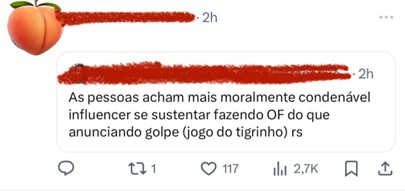
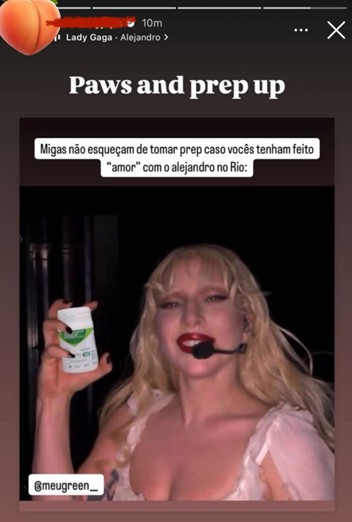 Translation: Paws and prep up – BFFs, don’t forget to take prep pills in case you have made “love” with Alejandro in Rio.